Money in a time of crisis

Introduction

Money makes the world go round. Money is the root of all evil. Whatever our attitude, careful thought goes into how we use our money, whether it is paying the rent or how much to spend on the weekly shop. But what happens when the money in our purses and our pockets suddenly loses value? This online exhibition explores instances when this has happened in the past.

Economic crises in different parts of the world and at different times in history have caused severe problems with the money in everyday use. The worldwide financial crash of 2008, the coronavirus pandemic of 2020, and the recent unilateral raising of tariffs by US President Trump in 2025, showed just how vulnerable economies can be to unforeseen events.

The impacts on individuals, businesses, and the economies of states can be traumatic. In 1920s Germany, run-away inflation made paper money worth so little that wheelbarrows were used to carry all the banknotes needed to buy a loaf of bread. Savings became worthless and people could not afford to eat.

Working with Dr Stefano Locatelli, Manchester Museum is exploring how money in everyday use has been affected by crises. We want to better understand the material we have in our rich collection, show the importance of finance in all our lives and highlight the threat to the very existence of coins and banknotes posed by digital transactions.

Title image: Hoard of fifty-five late Roman bronze coins 3rd - 4th century CE. Photostock-Israel / Science Photo Library

A Roman credit crisis
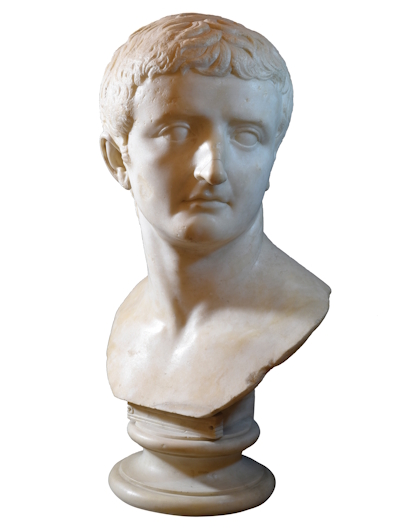
Bust of the emperor Tiberius, 14-37 CE. National Archaeological Museum of Naples. Marco Ansaloni / Science Photo Library

In the reign of emperor Tiberius (14-37 CE), the Roman empire experienced what we now recognise as a ‘credit crunch’. Many members of the ruling class faced loss of status and financial ruin. What caused this unexpected crisis? As is the case today, rich people could increase their wealth by lending sums of money at interest. Many years earlier, Roman emperor Julius Caesar had laid down rules for lending and holding land in Italy. We don’t know the precise details, but his law limited how much of someone’s fortune could be lent at interest. The law also required that some wealth was held in the form of land. The law was ignored for many years.

When the law was finally enforced in 33 CE, there was an outcry. People with personal wealth of more than 60,000 sesterces (a type of Roman coin) were forced to recover the money that they had lent to others so that they could buy land. Eighteen months were allowed for people to put their affairs in order, but debtors still found it difficult to repay the money they had borrowed.

When debtors tried to sell their estates to raise money too much land came onto the property market all at once and prices fell sharply. Even relatively wealthy landowners were reduced to poverty because their property was suddenly worth less than before. They could not find the money needed to repay the loans they had taken out.

The problem was only resolved when Tiberius made available one hundred thousand sesterces interest-free for three years to those who were struggling. Thanks to the emperor’s action the crisis passed. The episode shows that the Roman economy was vulnerable to a lack of liquidity – the availability of ready money in the form of coins.
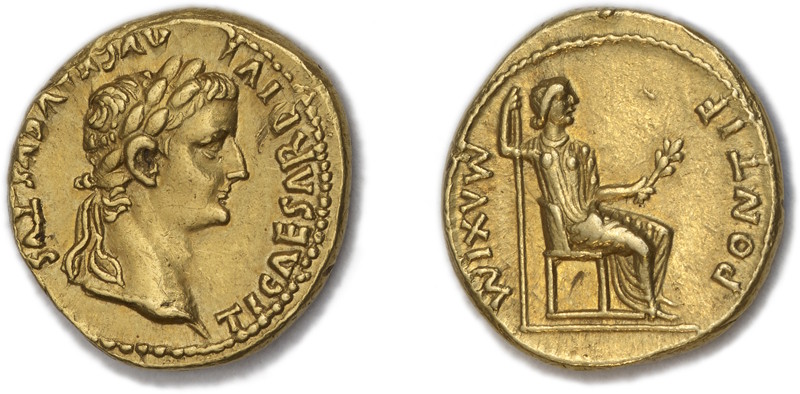
Gold aureus of Tiberius, 14-37 CE(1958.1.1528; diam. 18 mm)
Manchester Museum, The University of Manchester


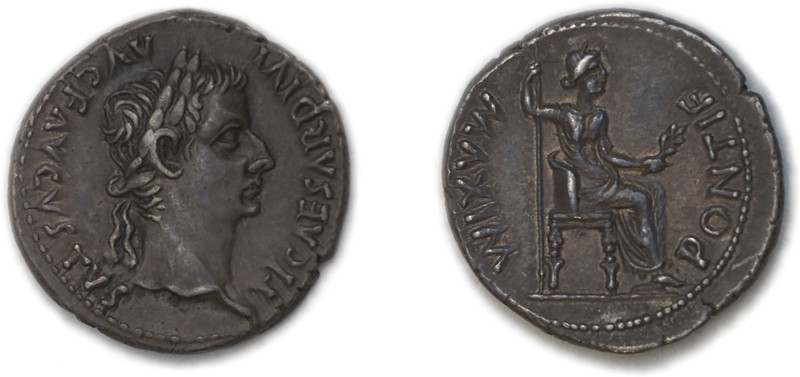
Silver denarius of Tiberius, 14-37 CE(1958.1.1529; diam. 18 mm)
Manchester Museum, The University of Manchester


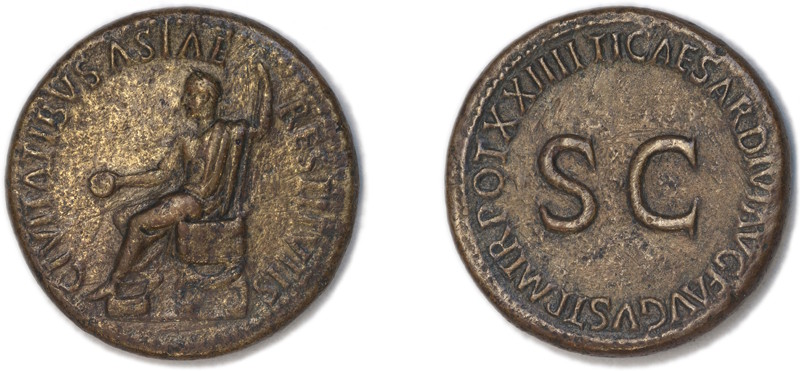
Brass sesterius of Tiberius, 14-37 CE(1926.1.944; diam. 34 mm)
Manchester Museum, The University of Manchester


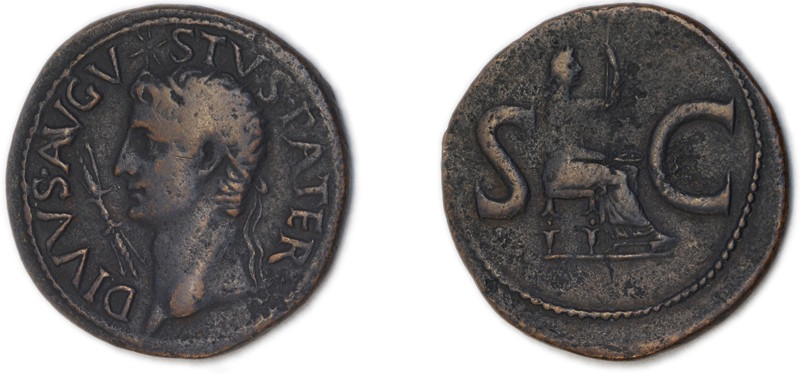
Copper dupondius of Tiberius for his adoptive father Augustus, 14-37 CE (ex Whitworth Art Gallery, no. 340; diam. 29 mm)
Manchester Museum, The University of Manchester


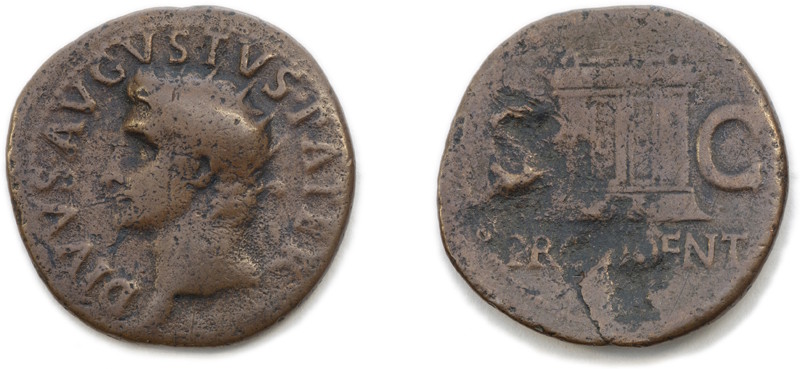
Copper as of Tiberius for Augustus, 14-37 CE (GMAU Collection; diam. 29 mm)
Manchester Museum, The University of Manchester

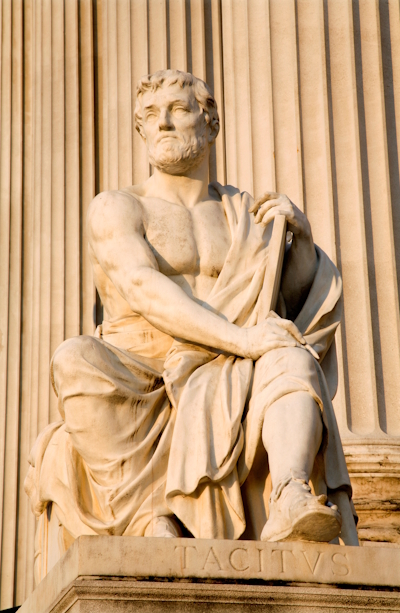
Statue of the Roman historian Tacitus, 56-120 CE, outside the Austrian Parliament building, Vienna. Tacitus is renowned for his accounts of the early Roman Empire in the Annals and the Histories. Jozef Sedmak-Alamy Stock Photo

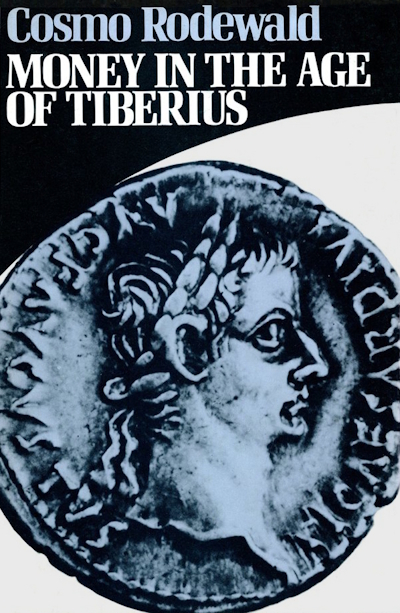
Cosmo Rodewald’s Money in the Age of Tiberius, a scholarly discussion of the monetary crisis. With permission of Manchester University Press

Statue of the Roman historian Tacitus, 56-120 CE, outside the Austrian Parliament building, Vienna. Tacitus is renowned for his accounts of the early Roman Empire in the Annals and the Histories. Jozef Sedmak-Alamy Stock Photo

Cosmo Rodewald’s Money in the Age of Tiberius, a scholarly discussion of the monetary crisis. With permission of Manchester University Press

The Roman Imperial currency crisis

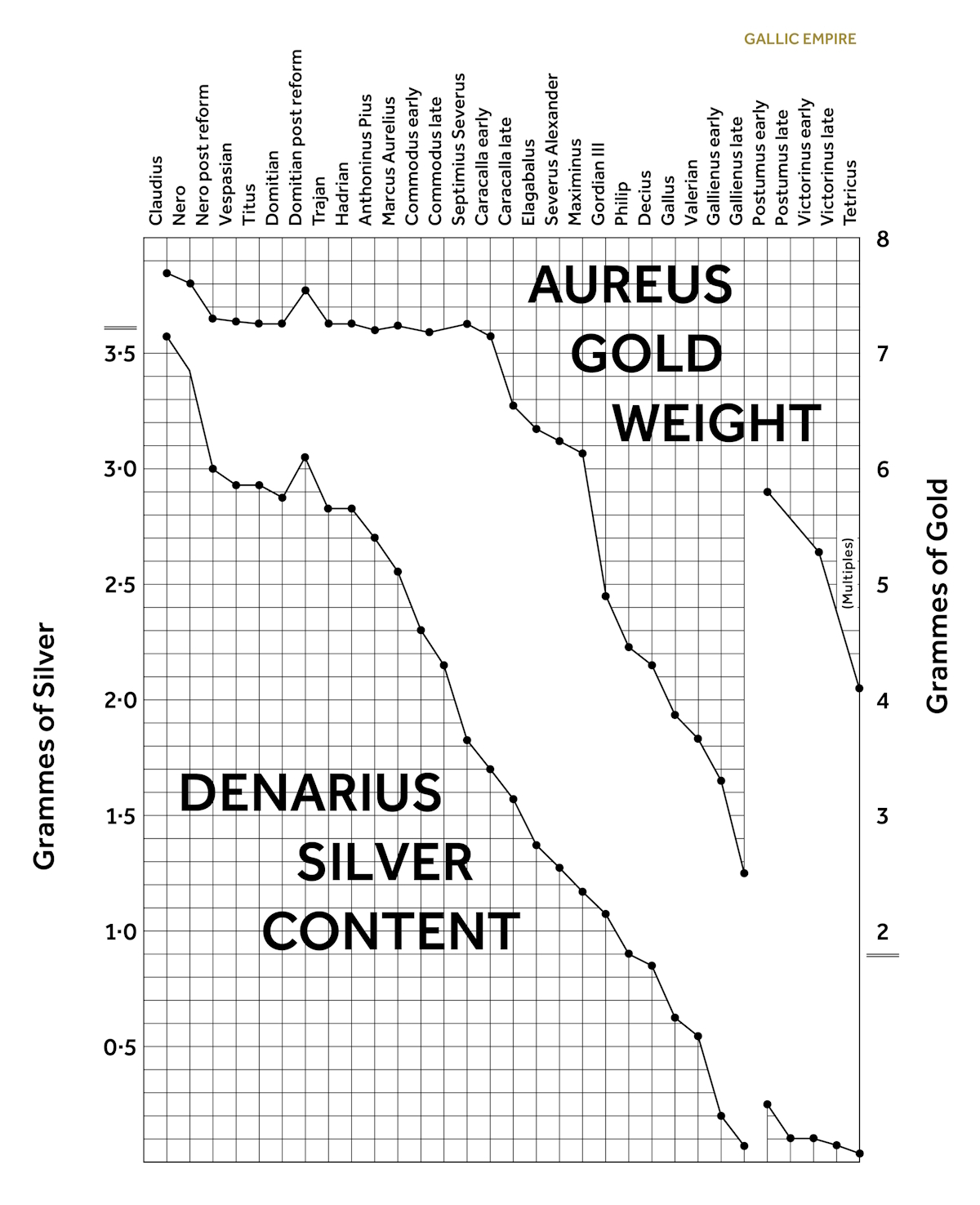
Graph showing the debasement of the Roman gold and silver currency system. After John Casey Roman Coinage in Britain (Shire Publications, 1984) with additional plotting by Dr Matthew Ponting (University of Liverpool)

From the 1st century CE, Roman emperors had to find ever more money to increase soldiers’ pay, to fund public works such as roads, aqueducts, and marketplaces and to put on entertainment for the masses. Trajan’s column and the surrounding forum of libraries, basilica and marketplace were funded by the plunder taken from the kingdom of Dacia to the west of the Black Sea (five million pounds of gold and ten million pounds of silver).

But conquest alone was not enough. The solution was to gradually reduce the amount of silver in the standard Roman silver coin called the denarius and to replace it with base metal. This allowed the Roman mint to make more silver coins, but each new issue of denarius coins contained slightly less silver than the previous ones.

In 215 CE, the emperor Caracalla (198-217 CE) created a new silver coin: the double denarius or ‘antoninianus’. But instead of it having twice the amount of silver it only had 1½ times as much. The Roman mint made a profit by calling in high value silver coins from earlier reigns and sending out coins with a lower silver content. During the third century, the silver content of Roman coins fell to a tiny fraction of what it had once been. At the same time, people gradually removed the coins with a greater silver content from circulation, preferring to save these coins in hoards.

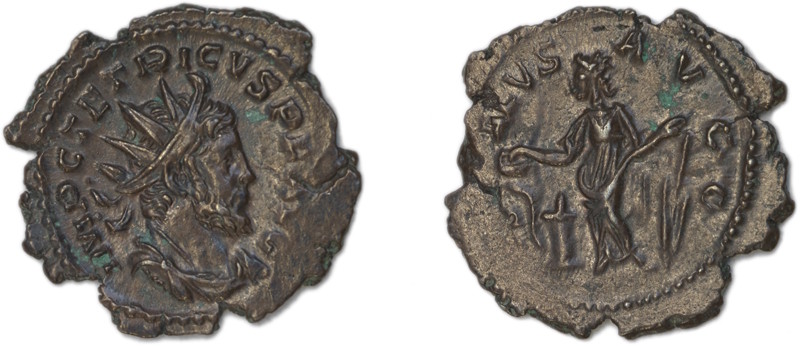
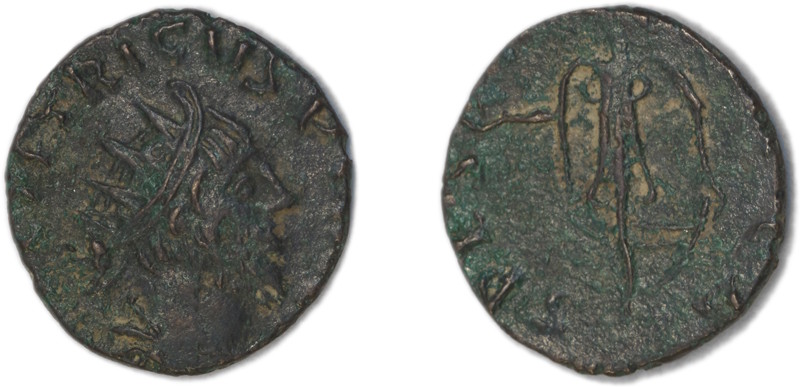
By the reigns of the emperors Claudius II (268-70 CE) and Tetricus I and II (270-3 CE), the supposedly silver coinage was almost entirely made of copper. The coins were small and often badly made. Lower value copper, bronze and brass coins called asses, dupondii and sestertii were no longer produced. Originally, they had been fractions of the silver denarius but once the silver coin became a copper coin, they were practically worthless.

People lost confidence in the poor-quality coinage. Traders increased their prices, causing inflation. Soldiers were paid in kind rather than with coins. The salt that was given to them instead of cash gives us our word salary. Towards the end of the 3rd century, soldier emperors reunited the empire and made some improvements to the currency. Any return of fiscal confidence was short-lived, however. The emperor Diocletian (284-305 CE) and his 4th century successors had to repeatedly reform the Roman coinage.

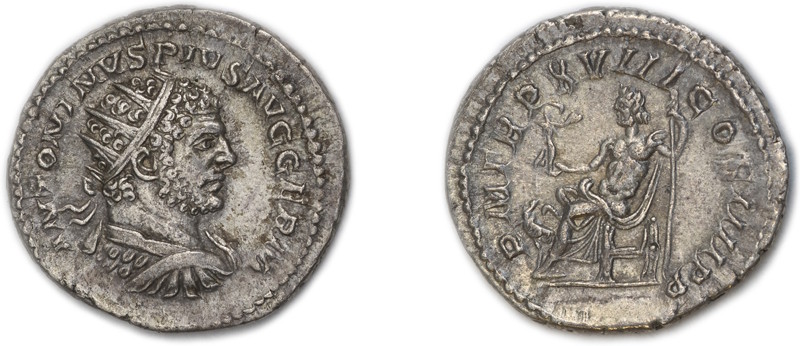
Silver antoninianus of Caracalla, 198-217 CE The emperor is shown wearing a ‘radiate’ diadem from which emanate solar rays. Although this looks like a crown, the radiate headdress showed that the value was double that of a single denarius.
(1926.2.423; diam. 23.5 mm)
Manchester Museum, The University of Manchester


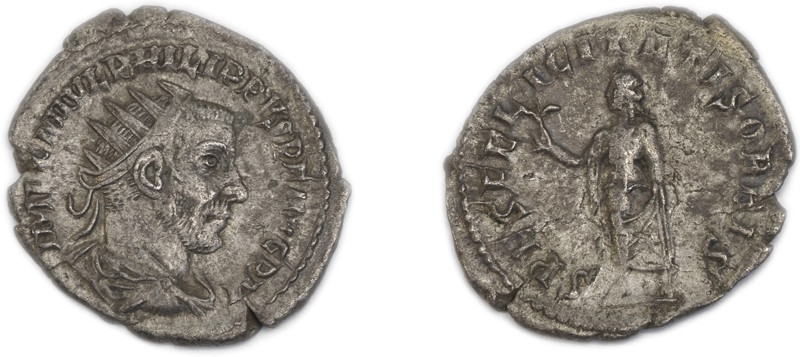
Silver antoninianus of Philip I ‘the Arab’, 244-249 CE The antoninianus had a silver content of 40% in Philip's reign.
(1926.2.538; diam. 24.5 mm)
Manchester Museum, The University of Manchester


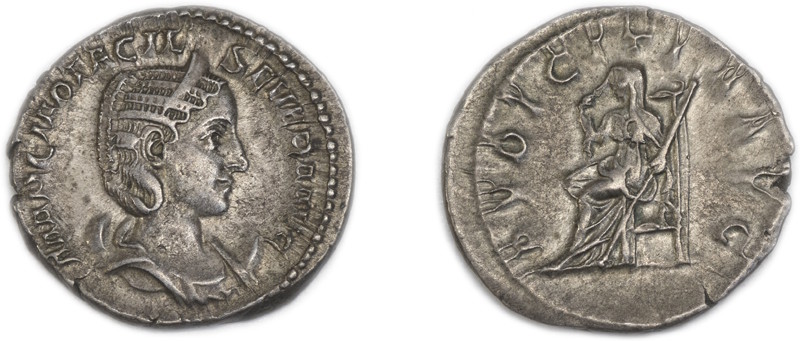
Silver antoninianus of Marcia Otacilia Severa, wife of Philip I, 244-249 CE (1958.1.2655; diam. 22.5 mm)
Manchester Museum, The University of Manchester


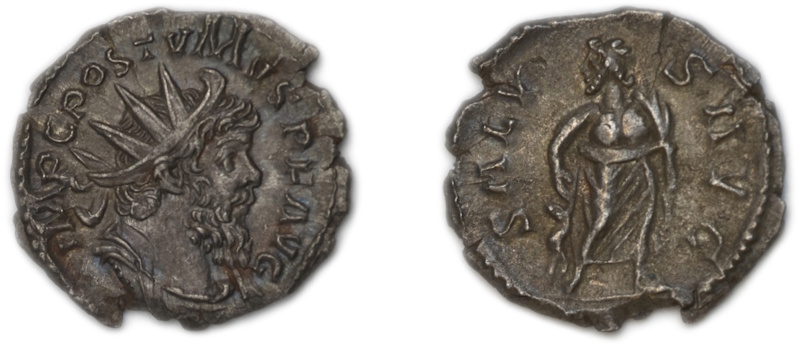
Silver and copper alloy or billon antoninianus of Postumus, 260-269 CE Postumus was emperor of a group of breakaway western provinces of the Roman Empire known as the Gallic Empire. The antoninianus contained 20% silver at the start of his reign but fell to lower levels.
(1926.1.661; diam. 20 mm)
Manchester Museum, The University of Manchester


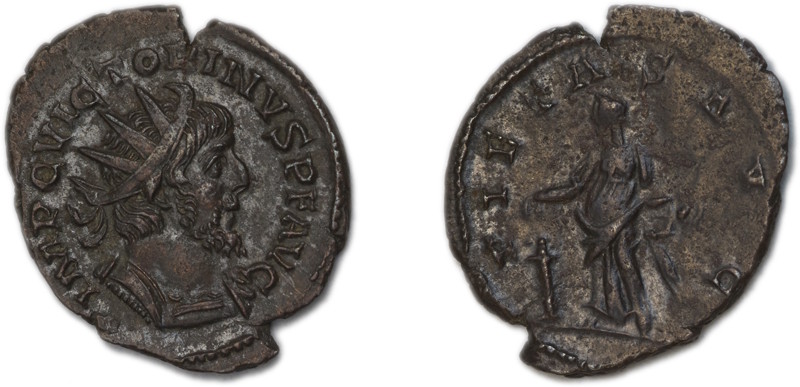
Silver and copper alloy or billon antoninianus of Victorinus, ruler of the Gallic Empire, 268-270 CE (1926.1.3377; diam. 23 mm)
Manchester Museum, The University of Manchester


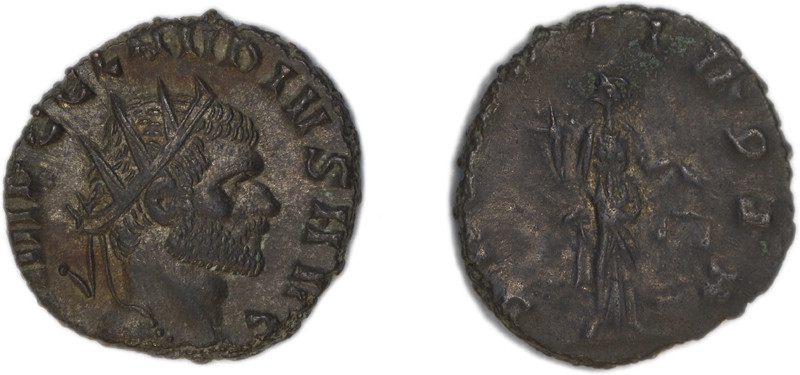
Silver and copper alloy or billon antoninianus of the Roman emperor Claudius II, 268-270 CE The antoninianus had a silver content of just a few per cent during Claudius’ reign.
(1926.1.3401; diam. 18 mm)
Manchester Museum, The University of Manchester


Silver and copper alloy or billon antoninianus of Tetricus I, emperor of the breakaway Gallic Empire, 268-270 CE The antoninianus was almost entirely made of bronze during Tetricus’ reign.
(Ex GMAU collection; diam. 16 mm)
Manchester Museum, The University of Manchester


Copper alloy radiate copy of an issue of Tetricus I, c.270-290 CE Copies of coins circulated alongside official issues in late 3rd century Britain.
(Ex GMAU collection; diam. 16 mm)
Manchester Museum, The University of Manchester


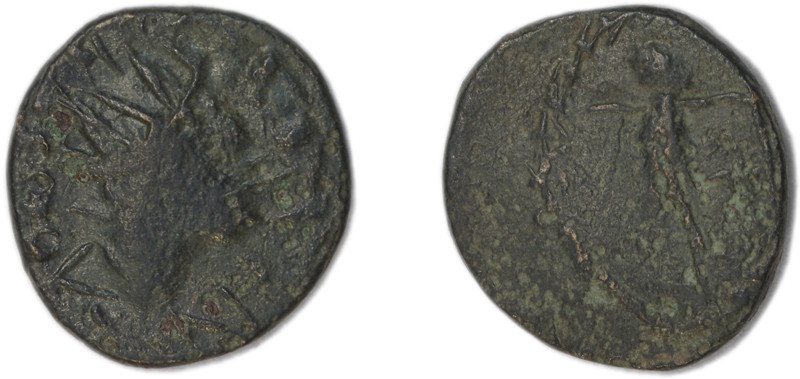
Copper alloy radiate copy of c.270-290 CE The emperor is hard to identify, the inscription illegible and only the radiate diadem stands out. There is no silver content.
(Ex GMAU collection; diam. 15 mm)
Manchester Museum, The University of Manchester


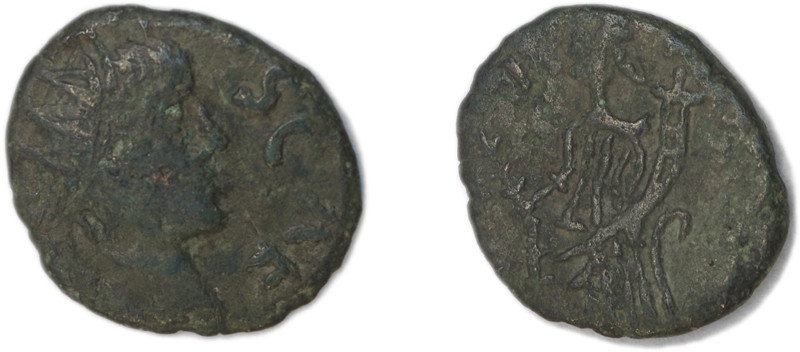
Copper alloy radiate copy of an issue of Tetricus II, c.270-290 CE The inscription is illegible and there is no silver content. Coins like this have been found in such large numbers they must have circulated and been accepted as money even if very low value.
(Ex GMAU collection; diam. 15 mm)
Manchester Museum, The University of Manchester


Copper alloy radiate copy of c.270-290 CE A cast copy with an irregular shape and barely recognisable as a Roman coin.
(Ex GMAU collection; diam. 14 mm)
Manchester Museum, The University of Manchester

The rise and fall of paper money in China

The first truly paper-based monetary system was created in China during the Northern Song dynasty (960-1127). China’s economy was more sophisticated than that of Europe at this time. To meet the demands of trade the Northern Song minted 260 million strings of copper coins known as cash (a string usually held 1000 coins) but this was not enough. The authorities began issuing paper notes to increase the amount of money in circulation.

The idea of using paper as money dates from the Tang dynasty (618-907) when people left goods and valuables with businesses for safekeeping and received a paper receipt in return. Traders realised that since the value of the paper receipt matched the value of the property, the notes could be used as a means of exchange. Using paper documents to pay a debt was more convenient than transporting thousands of heavy copper or bronze coins over long distances. The state strictly controlled the use of paper receipts as money and the punishment for counterfeiting was death.

The Chinese experiment with paper money was very successful for a time but as more and more notes circulated, prices increased because too much money was chasing the goods and services available. During the Southern Song dynasty (1127-1279), high rates of inflation crippled the Chinese economy. For example, the cost of a measure of rice rose from 100 to 3,400 copper coins. People lost confidence in the money in circulation and preferred to barter commodities such as silk to get what they needed.

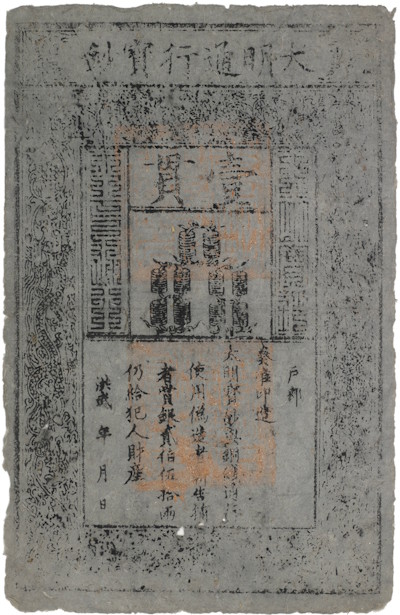
After defeating the Southern Song, the Mongols (an Asian people who built a huge empire originating in present-day Mongolia) ruled China as the Yuan dynasty (1279-1368). Rulers such as Kublai Khan (1260-1294) had the power and authority to compel people to use paper money instead of coins. European travellers such as Marco Polo (1254-1324) were astonished to see paper notes being used as money. Both the Yuan and the following Ming dynasty (1368-1644) printed too many notes, causing inflation that led to a loss of confidence. Silver and copper coins were preferred because they retained their intrinsic value as a means of exchange. These problems made later dynasties reluctant to use paper money.
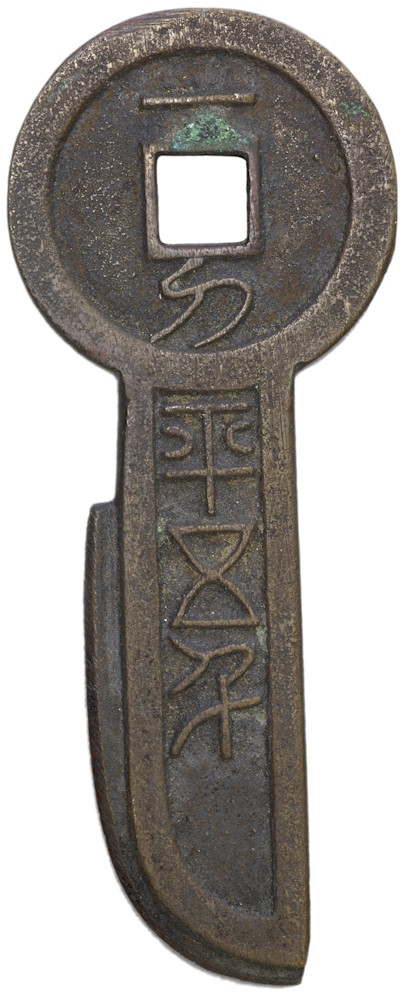
Forgery of knife money originally issued during the reign of Emperor Wang Mang, 9-23 CE Before the introduction of paper money, China used various types of currencies. This counterfeit knife coin was created in response to Emperor Wang Mang’s radical monetary reforms which revived ancient coins but assigned them unrealistically high values. As these changes disrupted trade and devalued wealth, many people began casting their own coins to reduce financial losses.
(East Asia 443; length 71 mm)
Manchester Museum, The University of Manchester


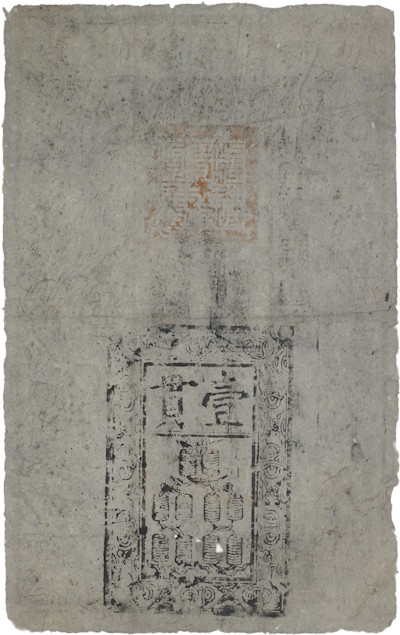
Paper money from Ming Dynasty, 1368-1644 (OH.7; height 340 x width 220 mm)
Manchester Museum, The University of Manchester

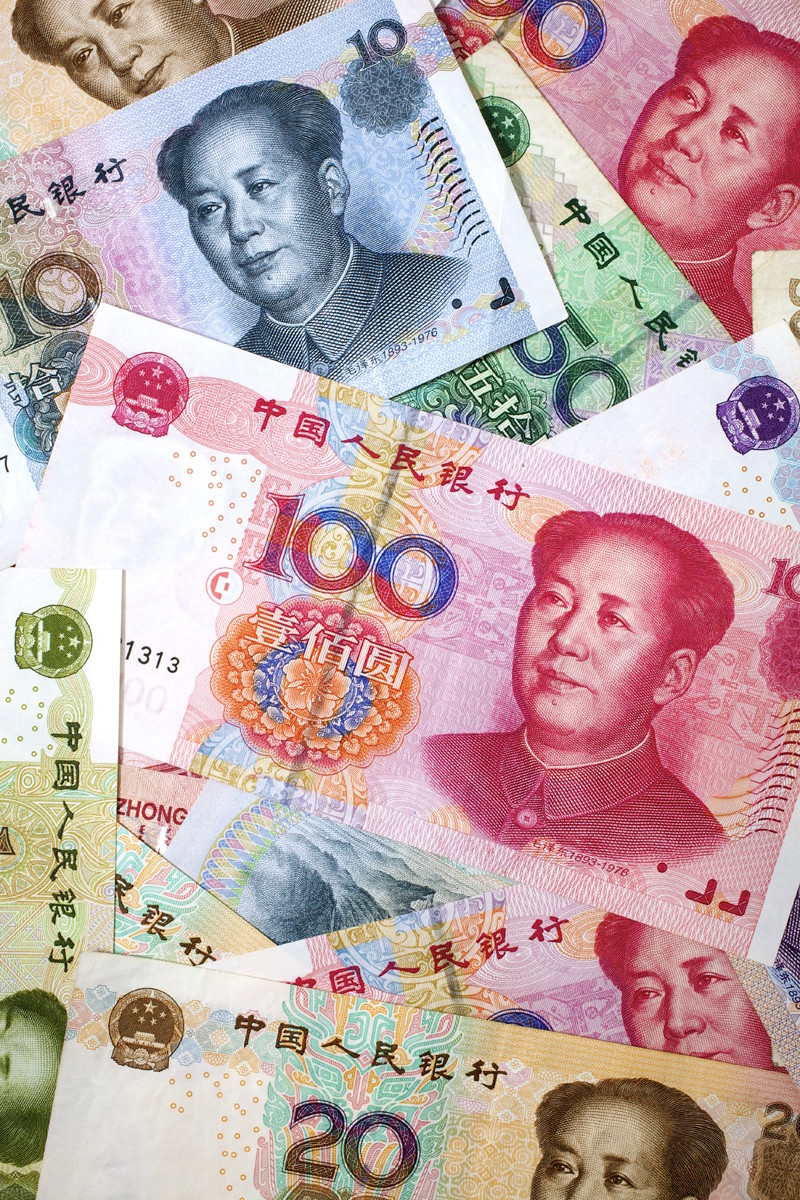
The current Chinese paper money is the renminbi (CNY), with the primary unit being the yuan. The renminbi was introduced in the 1940s around the same time as the founding of the People's Republic of China (PRC). These notes are from the fifth series of banknotes, printed in 1999, with a second edition in 2005 Tim Lester / Science Photo Library

Paper money in early modern Sweden

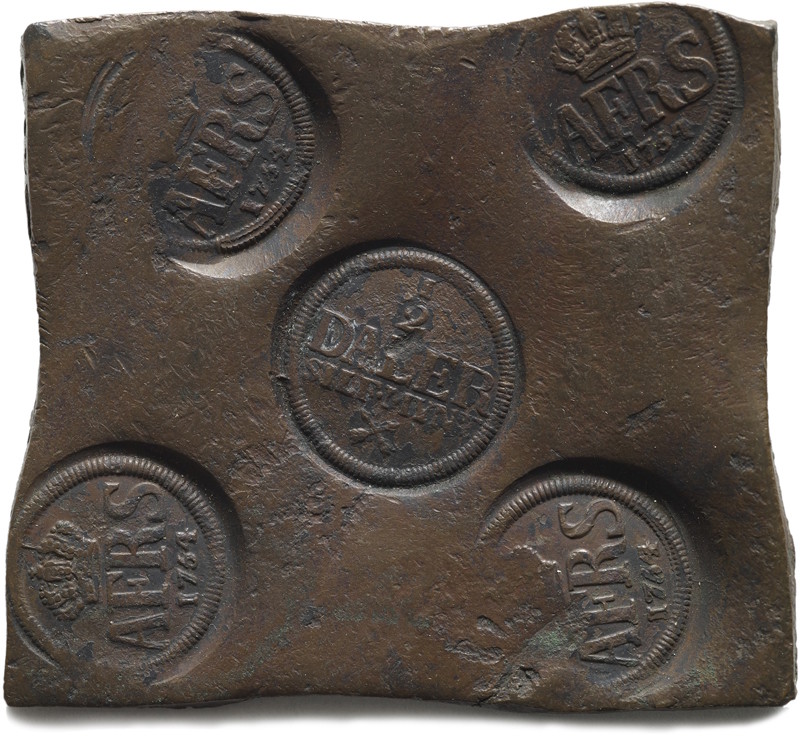
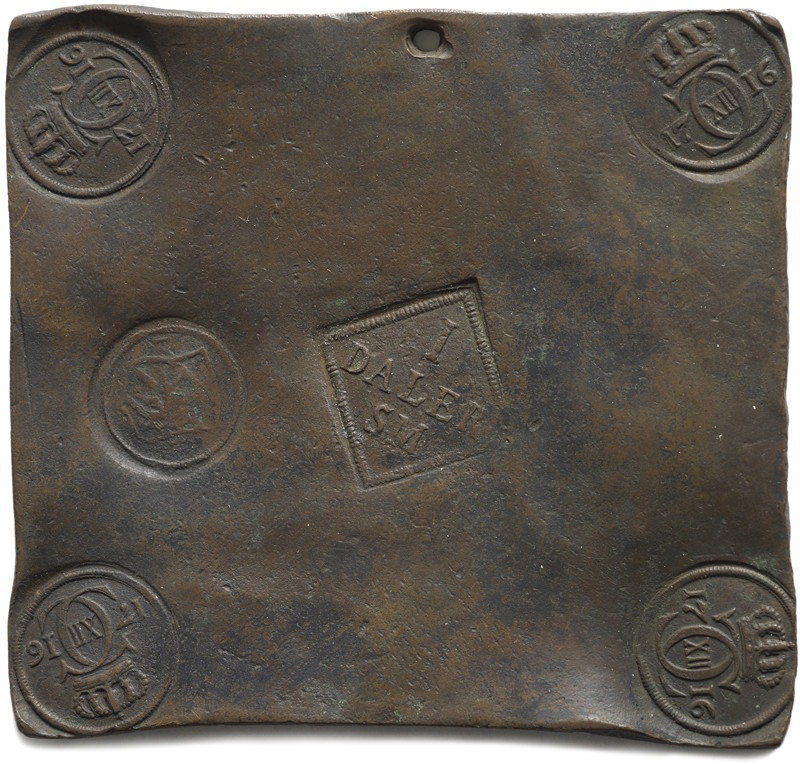
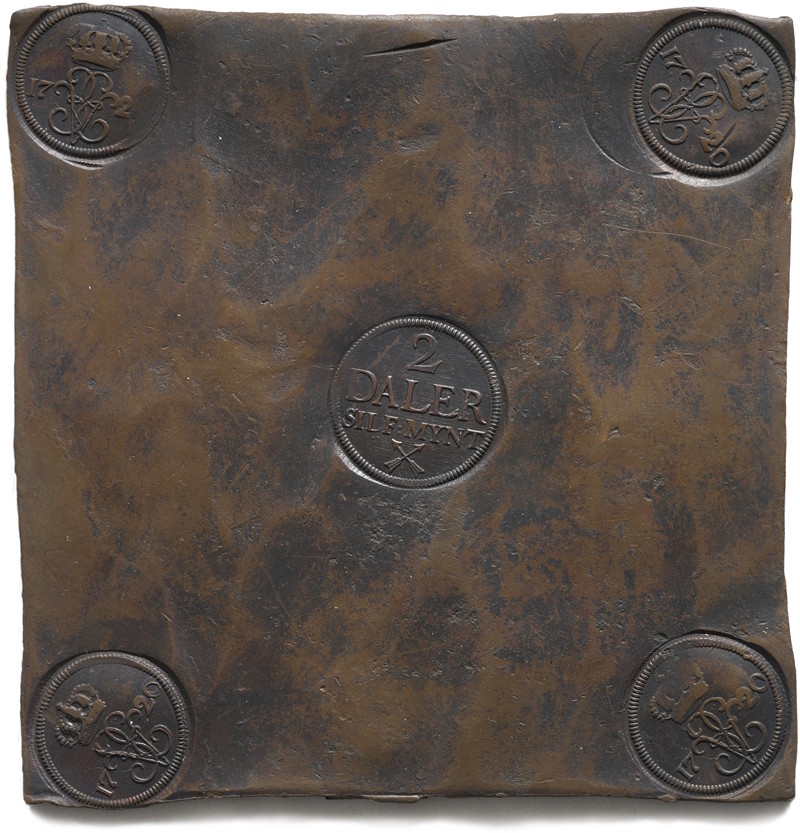
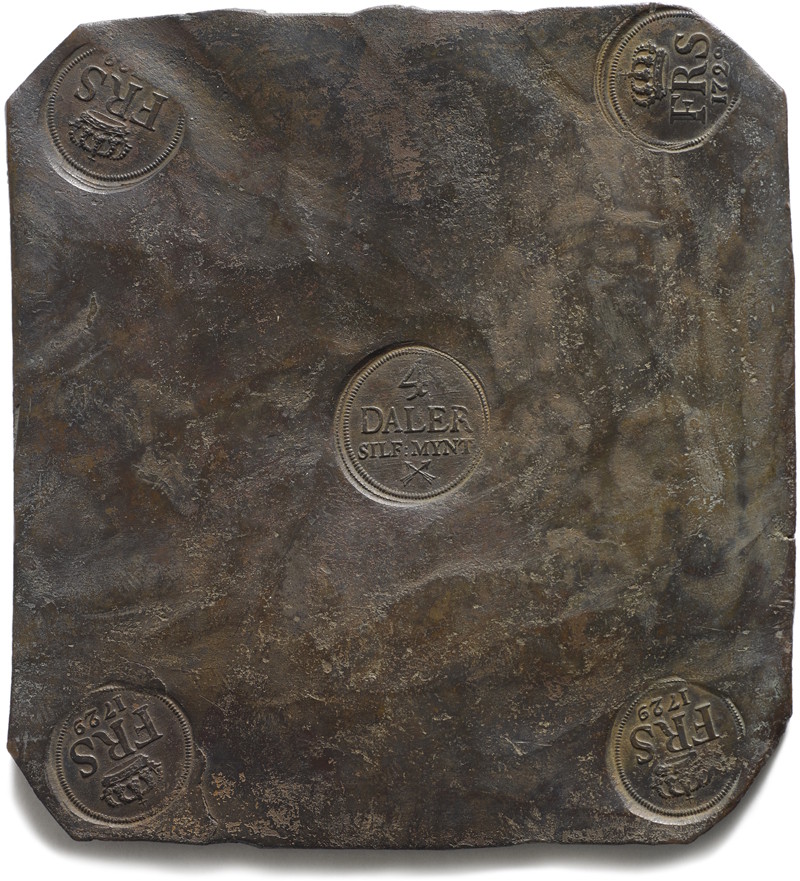
In the 16th and 17th centuries the economy of Sweden was in great difficulty because the country could not afford the heavy cost of the wars it was fighting. There was little silver available to make coins, but Sweden had rich copper deposits. Large copper plates were used as money instead. This was initially successful but after a time people refused to accept that the plates were worth more than the value of the copper used to make them. The plates were also inconvenient to use because the larger the sum of money, the larger and heavier the copper plate had to be. Copper plates weighing as much as 15kg (equivalent to two car tyres) were used as money.

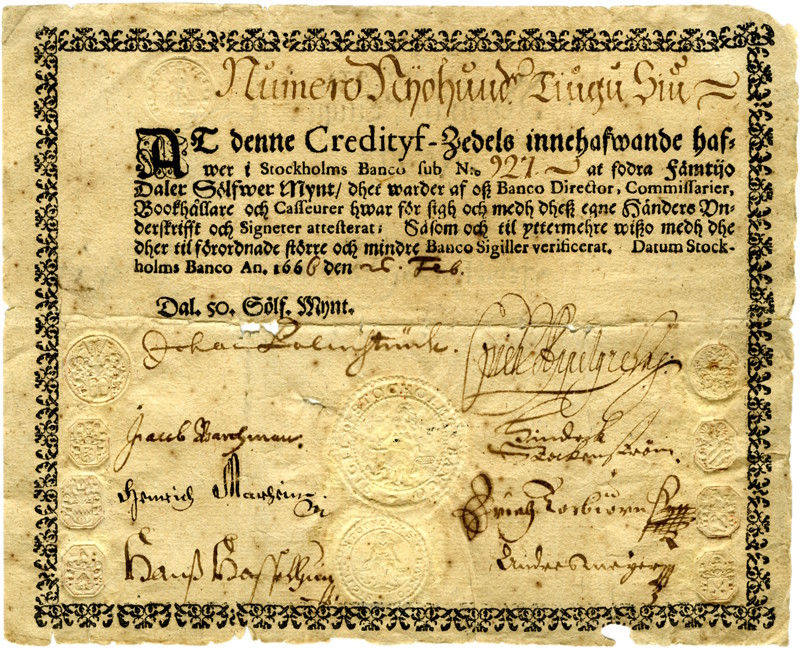
Sweden’s solution was to introduce paper money, which had been used in China for centuries. A Latvian financial expert, Johan Palmstruch (1611-1671), persuaded King Karl X Gustav (1654 - 1660) to open a new bank, the Stockholms Banco, in 1656. It was one of the first European banks to use paper money. Unfortunately, the bank printed too much paper money and prices rise when there is too much money in circulation. Despite this experience, paper money remained popular in Sweden because it was more convenient than using large lumps of copper. Its introduction led to the creation of the world’s first central bank, Sveriges Riksbank, which still exists today. 

Half daler silvermynt copper plate, King Adolf Frederick, 1764 (OC269; height 105 x width 98 x depth 8 mm )
Manchester Museum, The University of Manchester


One daler silvermynt copper plate, King Charles XII, 1716 (William Smith Churchill Collection, Scandinavia 893; height 150 x width 141 x depth 4 mm)
Manchester Museum, The University of Manchester


Two daler silvermynt copper plate, Princess Ulrika Eleonora, 1720 (Reuben Spencer Collection; height 196 x width 186 x depth 4 mm)
Manchester Museum, The University of Manchester


Four daler silvermynt copper plate, King Frederick I, 1729 (23081; height 240 x width 252 x depth 5 mm)
Manchester Museum, The University of Manchester

Paper money of 50 daler silvermynt, issued by the Stockholms Banco, 26 February 1666 (height 155 x width 193 mm )
Gabriel Hildebrand, the Economy Museum, Royal Coin Cabinet, Stockholm, Sweden

British trade tokens

In the mid-17th century, the British government stopped issuing a range of different coins, including low-value coins. They were expensive to make in relation to what they were worth, but stopping production caused problems because low value coins were very important for a wide range of everyday transactions. Without them, employers couldn’t pay their workers’ wages very easily. Everyday purchases, such as buying a loaf of bread, became difficult without loose change.
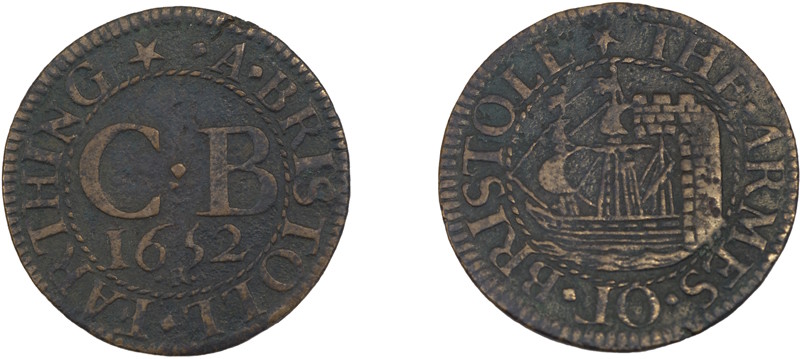
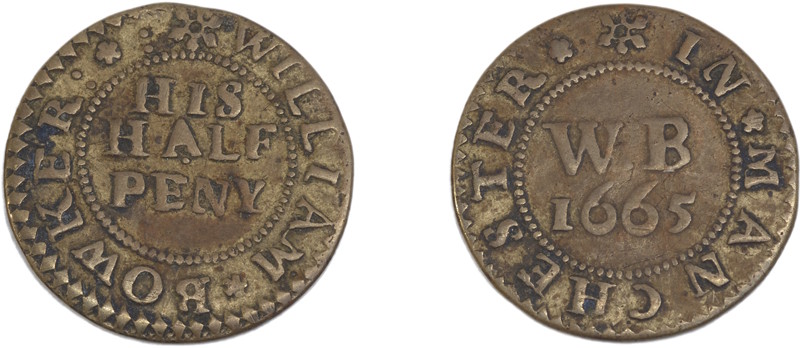
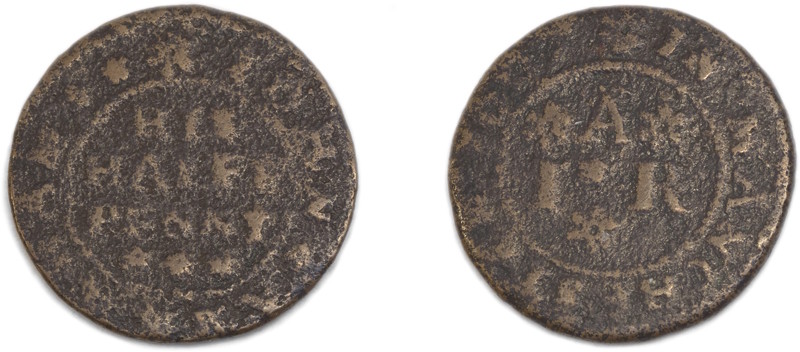
Shopkeepers and innkeepers across England, Wales and Ireland responded by issuing halfpenny and farthing tokens so that trading could continue. This situation lasted until 1672, when the mint (coin maker) started to produce official copper coins again for the first time.

There were further shortages of low value coins in the 18th and 19th centuries during the Industrial Revolution. One solution was to pay wages in kind: for example, factory workers might be paid in cloth and miners paid in coal. Others were paid in vouchers that could only be spent in the factory’s own shop. Workers were often charged higher prices in the factory shop but couldn’t spend their vouchers anywhere else. Another solution was for businesses to issue trade tokens or ‘currencies of convenience’. In this way, workers could be paid more easily, and traders could continue to sell their goods. But these arrangements were not controlled by the government and were open to abuse. Forgers and counterfeiters made copies of the tokens. Eventually the government started producing low value coins again and the trade tokens went out of use.
Copper farthing trade token, Bristol, 1652 Showing the letters CB or civitas (city of) Bristol and the arms of the city, a castle and a ship.
(1958.1.4436; diam. 21 mm)
Manchester Museum, The University of Manchester


Copper halfpenny token issued by Iohn Abraham, Manchester, 1667 (Local.7; diam. 20 mm)
Manchester Museum, The University of Manchester


Brass halfpenny trade token issued by William Bowker, Manchester, 1665 William Bowker was a grocer.
(1958.1.4457; diam. 19 mm)
Manchester Museum, The University of Manchester


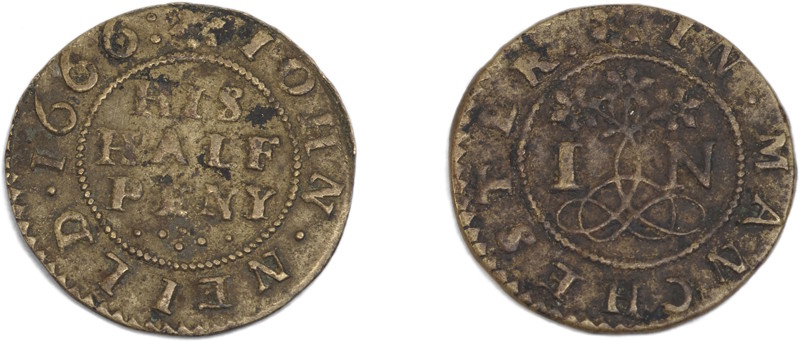
Brass halfpenny trade token issued by Iohn Neild, Manchester, 1666 (1958.1.4460; diam. 19 mm)
Manchester Museum, The University of Manchester


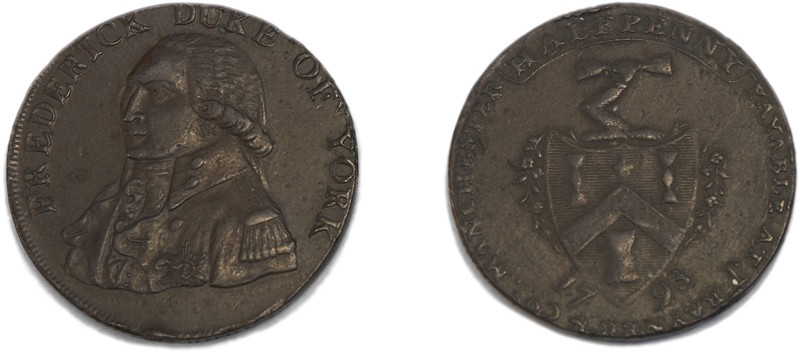
Copper halfpenny trade token issued by J. Rayner & Co., showing Frederick Duke of York, Manchester, 1793 These tokens appear to have been issued for profit as nothing is known of J.Rayner. The Duke of York was a popular public figure at the time and is celebrated in the well-known nursery rhyme.
(1958.1.4663; diam. 29 mm)
Manchester Museum, The University of Manchester


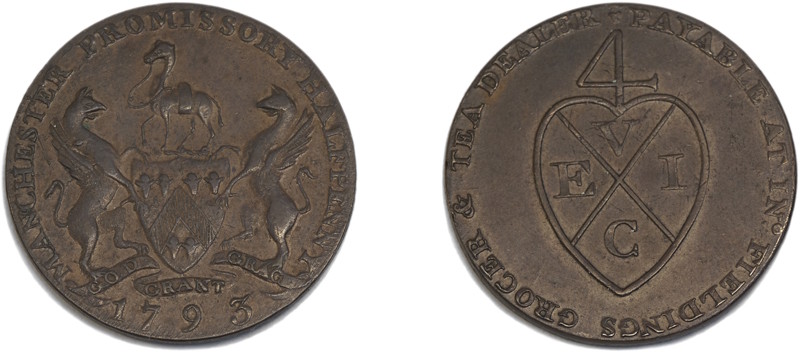
Copper halfpenny trade token issued by Fielding’s Grocer and Tea Dealer, Manchester, 1793 (Local.747; diam. 29 mm)
Manchester Museum, The University of Manchester


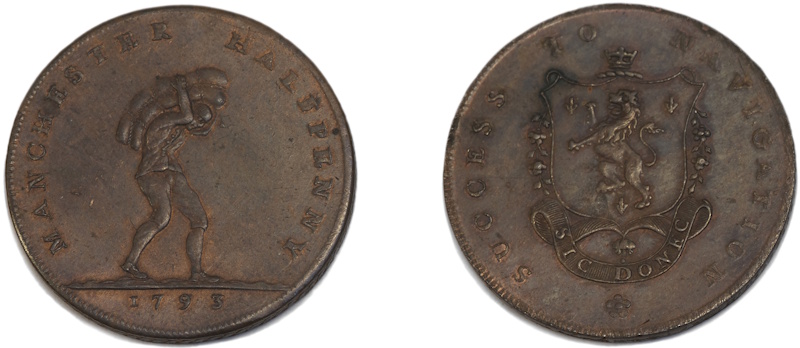
‘Success to navigation’ copper halfpenny trade token issued by the businessman James Condor, Manchester, 1793 Showing a man carrying what may be a bale of cotton and on the reverse the crest of the Duke of Bridgewater.
(1958.1.4663; diam. 29 mm)
Manchester Museum, The University of Manchester

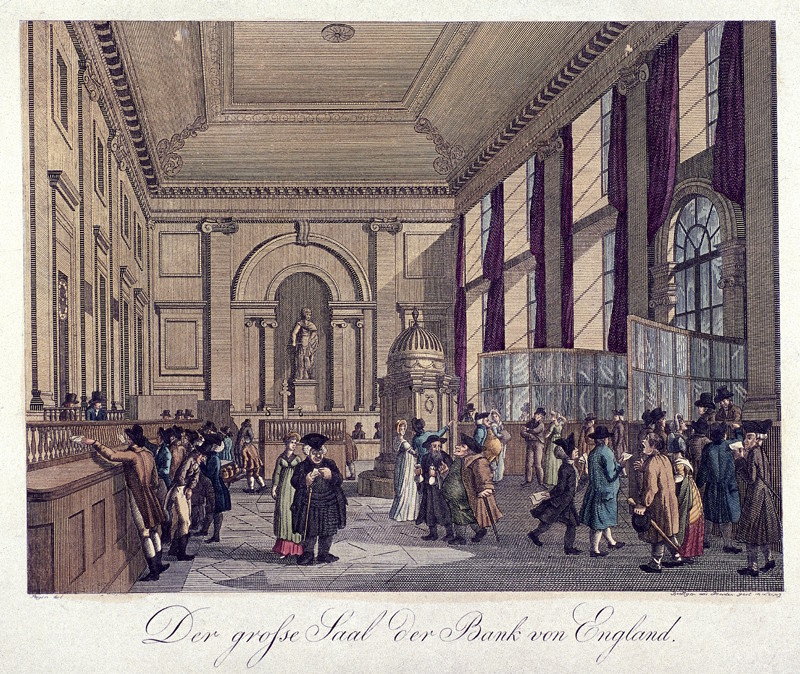
The Bank of England is the second oldest central bank in the world. Founded in 1694 in the City of London, its headquarters were moved to Threadneedle Street in 1734, where it remains today. This drawing shows the interior of its Great Hall bustling with customers and employees in 1808. The London Archives (City of London) / Heritage Images / Science Photo Library


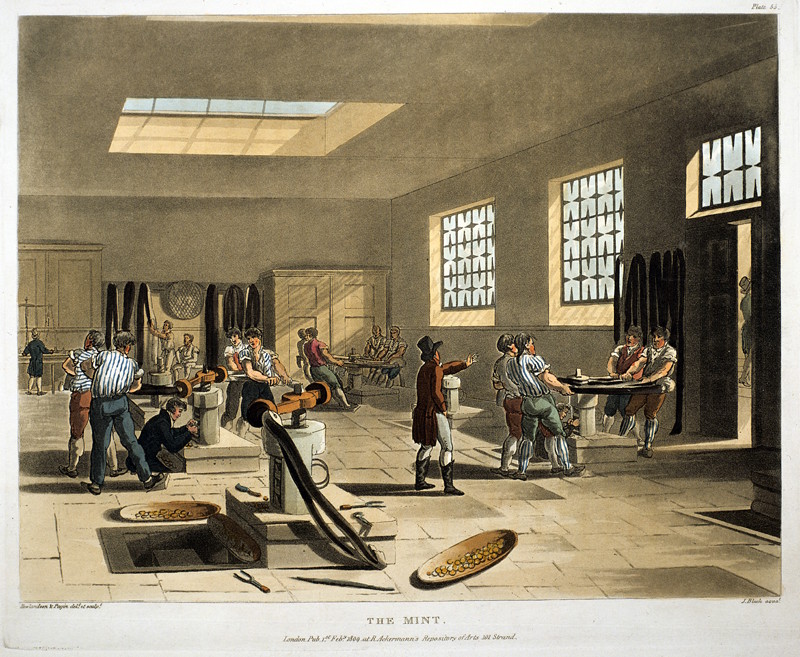
The Mint, London, 1808-1811. Coins being produced with coining presses, which were fully implemented at the Mint of London in 1662. This replaced the older hand-made process called ‘hammered coinage’, where coins were struck manually with hammers. From The Microcosm of London, published by Ackermann, London 1808-1811. Artist: Augustus Charles Pugin Oxford Science Archive / Heritage Images / Science Photo Library

Hyperinflation in 1920's Germany

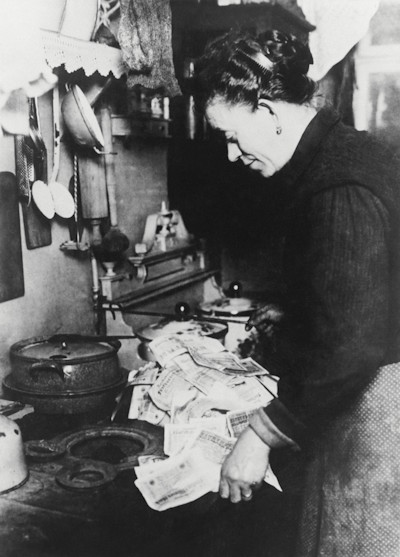
Woman burning German Papiermark banknotes as fuel during the German hyperinflation, when money had become cheaper than firewood or coal. Library Of Congress / Science Photo Library

During the First World War, the German government borrowed money from the people to pay for the cost of the conflict, promising to repay the debt when the war was won. The goldmark, the gold-standard currency of the German Empire, was abandoned and replaced by a banknote called the papiermark or paper mark.

But Germany lost the war and had to pay 132,000 million goldmarks (£6,600 million) in reparations. The post-war German Weimar Republic printed more paper banknotes but with insufficient gold reserves to guarantee their value. Previously, banknotes had to be backed by something valuable such as gold. By ignoring this rule, the financial authorities were free to print as much money as they pleased. This only worked as long as people had confidence in the government and its money. The large amount of paper money caused prices to rise dramatically. The value of the papiermark fell rapidly.

By 1923, everyday purchases cost billions of marks. Papiermarks were literally not worth the paper they were printed on. German shoppers needed a wheelbarrow full of banknotes to buy a loaf of bread. It was cheaper to burn paper money than to buy firewood or coal. People’s savings becam worthless.

The German government replaced the papiermark with a new currency, the Rentelmark, and cut twelve zeros from the values printed on the banknotes. The impact of the national economic crisis on ordinary Germans was traumatic. Extremely careful management and control of finances continues to be an important factor in the running of the modern German economy.

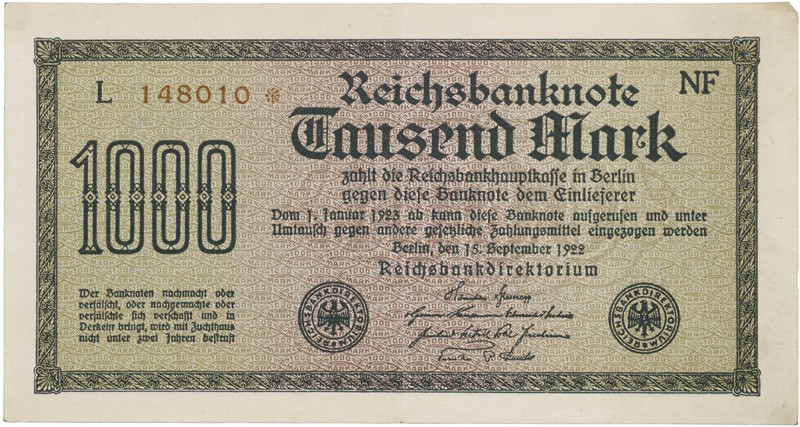
One thousand mark paper banknote, 15 September 1922 (height 85 x width 160 mm)
Manchester Museum, The University of Manchester


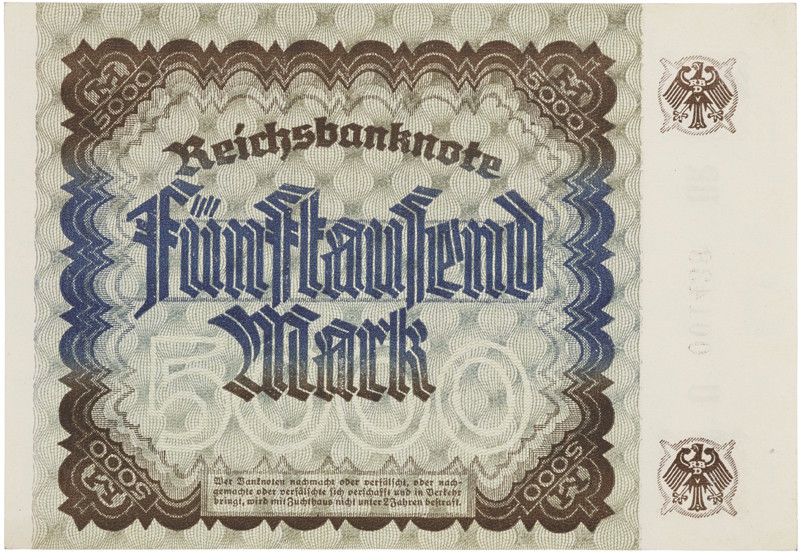
Five thousand mark paper banknote, 1922 (height 90 x width 131 mm)
Manchester Museum, The University of Manchester


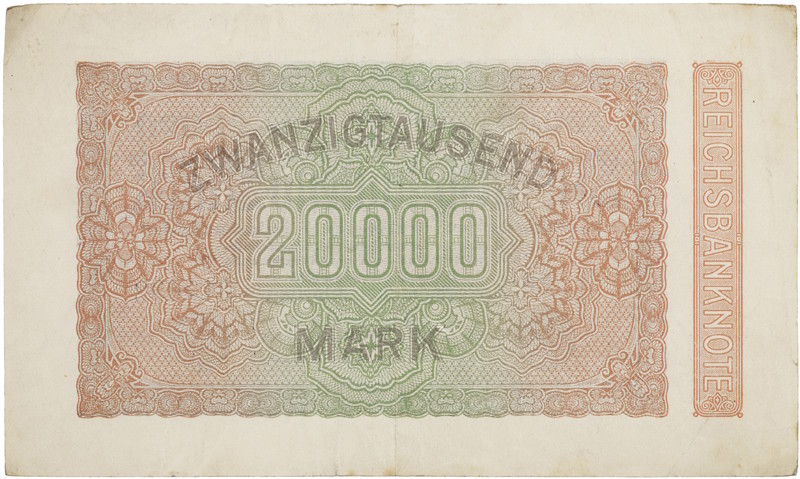
Twenty thousand mark paper banknote, 1923 (height 95 x width 161 mm)
Manchester Museum, The University of Manchester


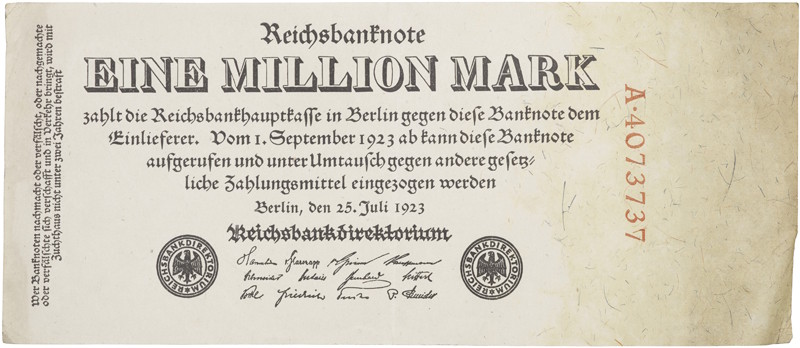
One million mark paper banknote, 25 July 1923 (height 79 x width 186 mm)
Manchester Museum, The University of Manchester


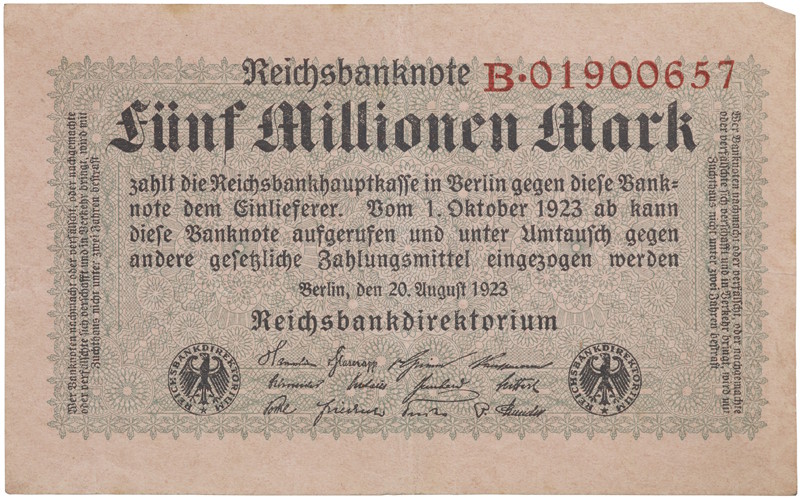
Five million mark paper banknote, 20 August 1923 (height 79 x width 127 mm)
Manchester Museum, The University of Manchester


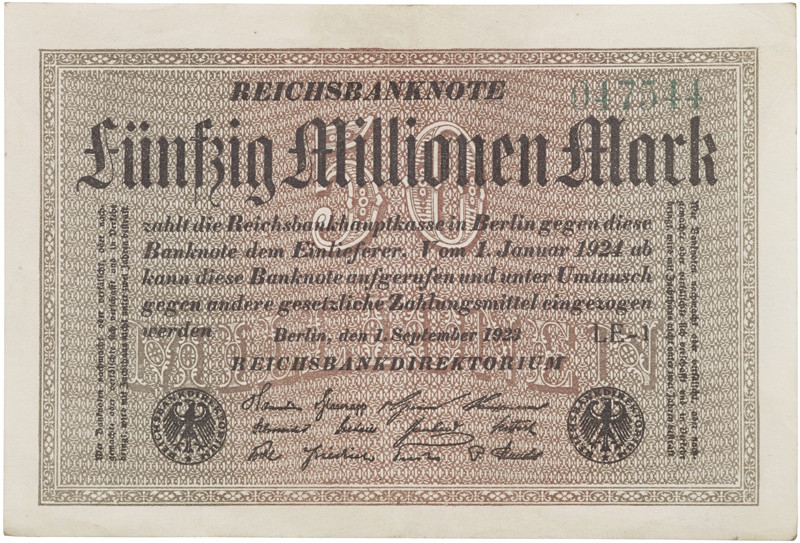
Fifty million mark paper banknote, 1 September 1923 (height 83 x width 124 mm)
Manchester Museum, The University of Manchester


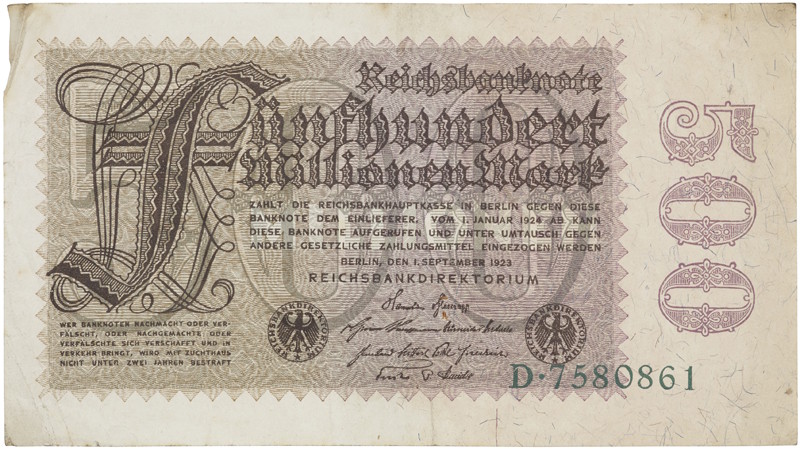
Five hundred million mark paper banknote, 1 September 1923 (height 86 x width 154 mm)
Manchester Museum, The University of Manchester

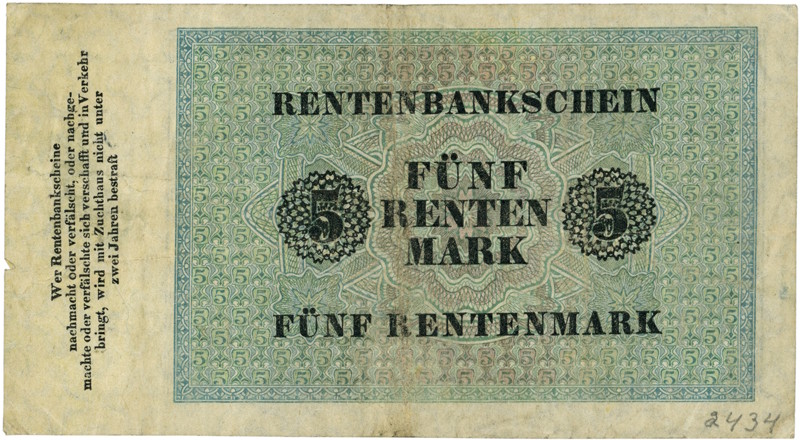
Five Rentenmark by Deutsche Rentenbank, Weimar Republic (1918-1933), 1923 Translation of side text:
‘Anyone who imitates or forges Rentenbank notes, or procures and puts into circulation imitations or forgeries, will be imprisoned for not less than two years.’
Tunefalk, Martin, Historical Museum-SHM (CC BY 4.0)

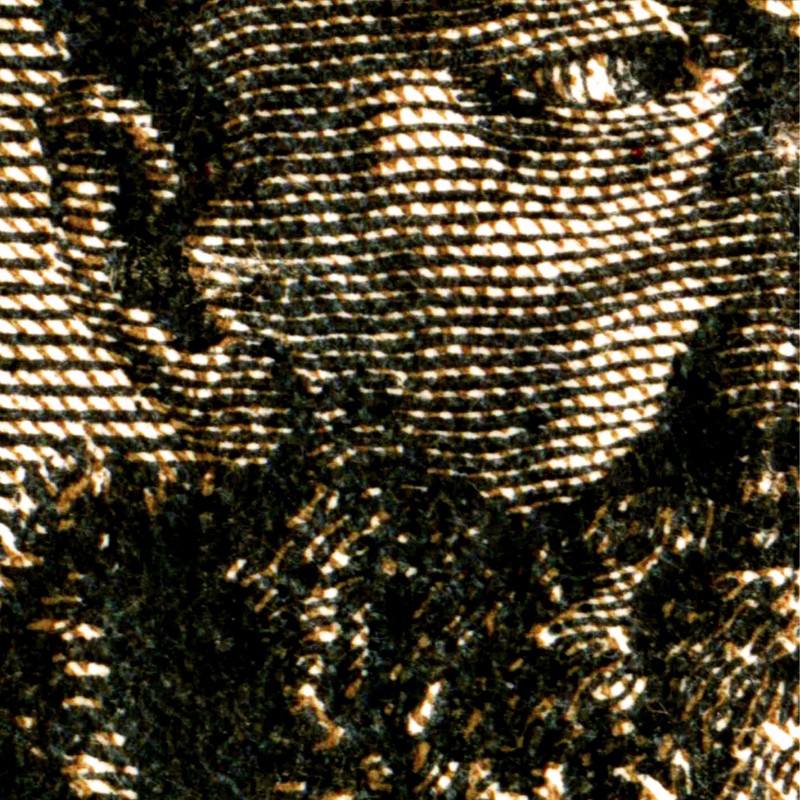
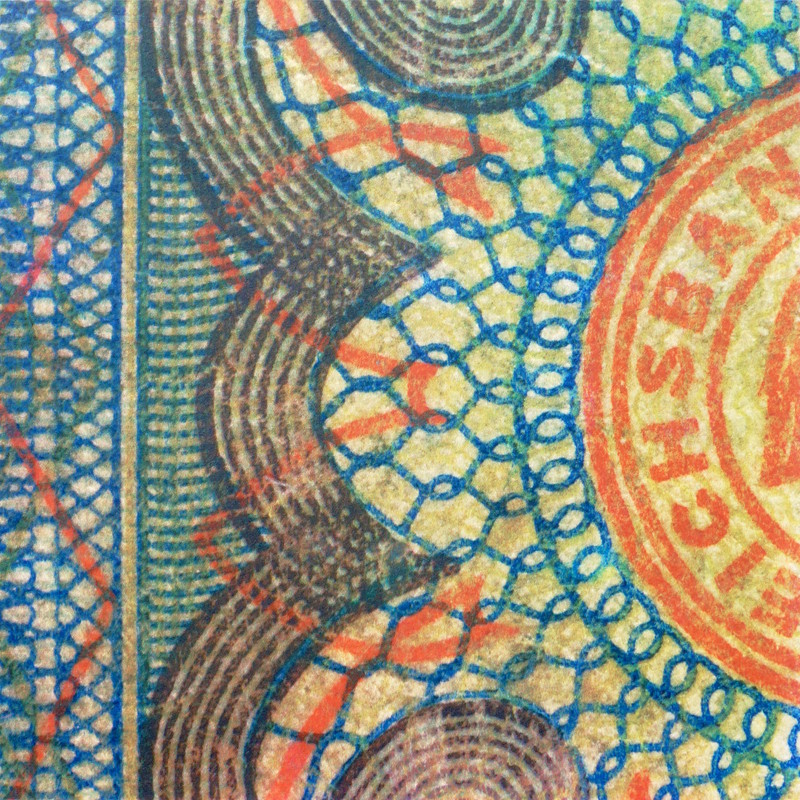
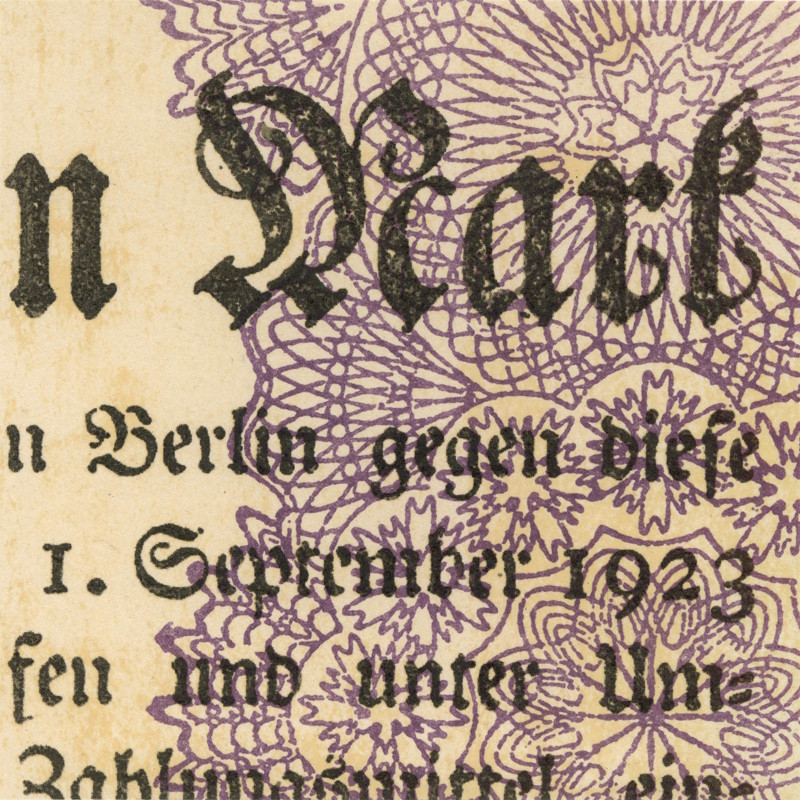
The following images are works of art by Heather J. A. Thomson from her Papiermark exhibition. Thomson invites viewers to reconsider Germany’s hyperinflation period by focusing not on statistics, but on the physical and visual qualities of the Papiermark banknotes. Through magnified images, she draws attention to the folds, stains, and tears that reveal the intense and desperate use of the notes, evidence of a currency that could no longer serve its intended purpose of providing economic stability. Her work highlights the intricate designs of these notes, both functional and beautiful, and questions their value, even to counterfeiters, in a time of economic collapse. By foregrounding their material presence, Thomson transforms the Papiermark into a complex historical object, rich with untold stories.

Detail of Eine Milliarde 15 Dezember 1922, Digital Print Installation © Heather J. A. Thomson


Hundert November 1920.1, Screen print, 2016, image 17 x 17 in., paper 22 x 22 in. © Heather J. A. Thomson


Zwei Millionen 9 August 1923.3, Photolithograph, 2018, image 5 x 5 in., paper 8 x 8 in. © Heather J. A. Thomson

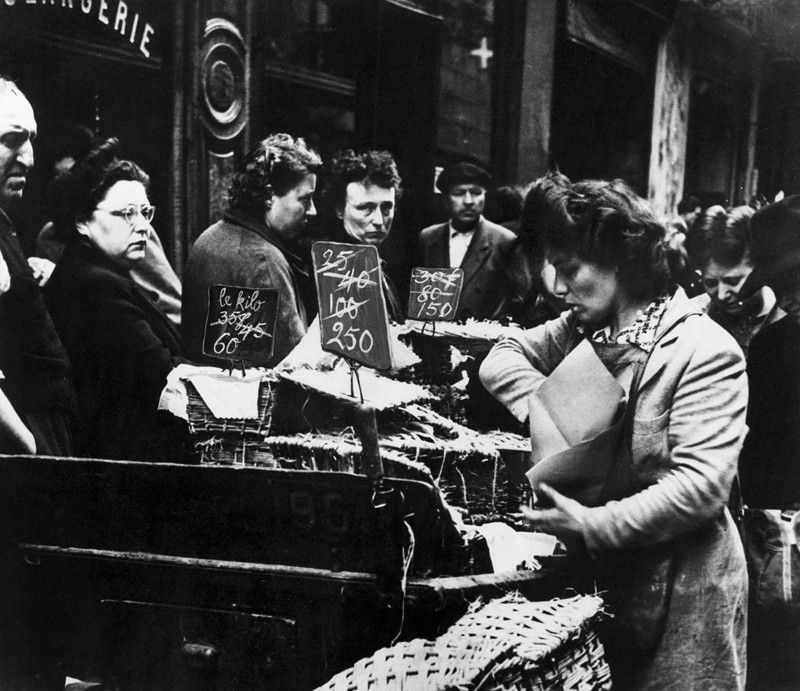
The saddling of Germany with reparations following the end of WWI ultimately led to hyperinflation and the rise of Nazism. During the period of WWII, the economic effects of war and severe shortages began to cause similar rapid price increases in France. To counteract this effect, the Marshall Plan provided aid from the USA to post-war Europe. Aid was provided from 1948 to 1952.

French market with marked prices shown rising rapidly during a period of monetary inflation in Europe after World War II. Some prices have risen by five times their initial amount with buyers needing large amounts of cash to purchase everyday goods. To counteract this effect, the Marshall Plan provided aid from the USA to post-war Europe. Aid was provided from 1948 to 1952. This photograph dates from the period 1948 to 1967. US National Archives And Records Administration / Science Photo Library

The Indian rupee and the Great Depression

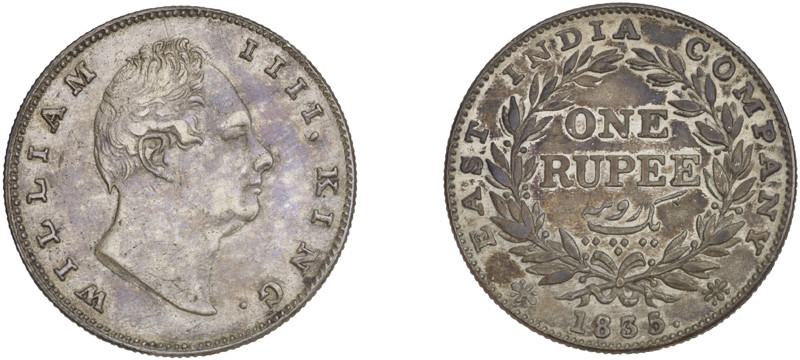
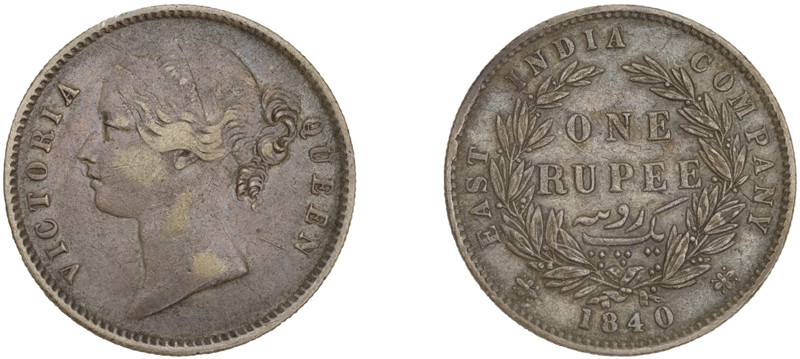
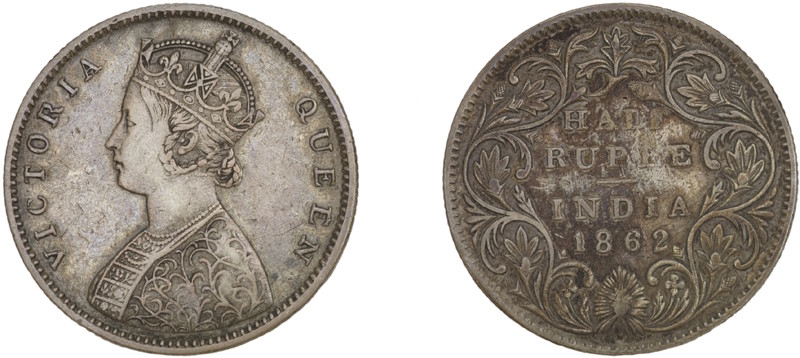
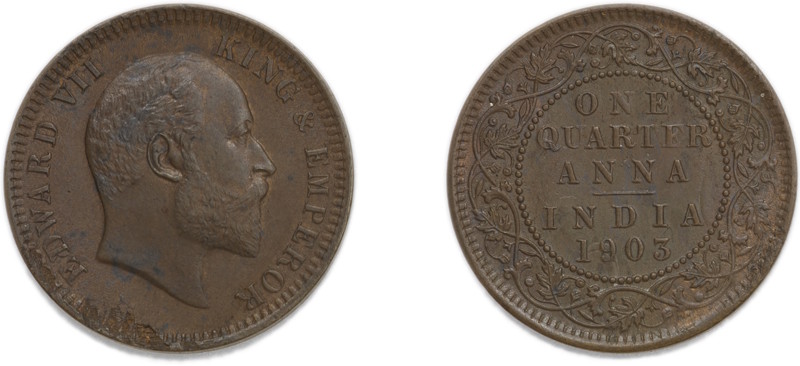
During the 19th century, the Indian rupee was a silver-based currency. When the price of silver started to fall after 1873, the rupee lost value in comparison to gold-backed currencies, including the British pound. This made Indian imports more expensive, and it was harder to pay Britain for the cost of colonial administration known as ‘home charges’. The price of food rose too and Indian people had to keep borrowing from money lenders to live, without hope of ever becoming debt-free.

From 1900, the rupee was linked to gold at a fixed exchange rate through British sterling for a time but that did not prevent the Indian rural debt crisis worsening during the Great Depression of 1929. The colonial government in India limited domestic money supply so that it could continue making payments to the UK. There was less liquidity and credit available, and the money lenders recalled loans and raised interest rates. Declining prices for agricultural exports also meant Indian farmers, who were already carrying high amounts of debt, were less able to repay their loans.

This situation worsened when the British sterling, and therefore the Indian rupee, could not maintain its link to gold after 1931. For millennia India had been a net importer of gold. What little savings people accumulated were usually kept in the form of gold jewellery, rather than bank deposits. The 1929-31 monetary and liquidity crisis meant that people had to resort to ‘distress’ selling of their gold, which found its way to the UK via the ‘home charges’. India turned into a net exporter of gold in the 1930s with disastrous consequences for India’s rural economy and people.

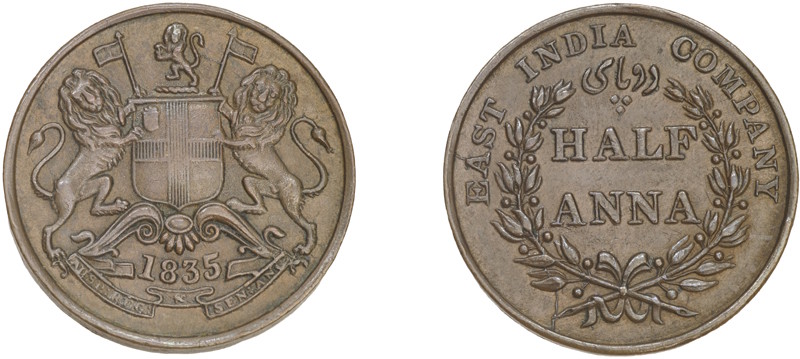
Copper half anna of the East India Company, 1835 (1921.2.88; diam. 31 mm)
Manchester Museum, The University of Manchester


Silver one rupee of King William IIII, 1835 (1921.2.3; diam. 30.5 mm)
Manchester Museum, The University of Manchester


Silver one rupee of Queen Victoria, 1840 (1921.2.4; diam. 31 mm)
Manchester Museum, The University of Manchester


Silver half rupee of Queen Victoria, 1862 (1921.2.13a; diam. 24.5 mm)
Manchester Museum, The University of Manchester


Bronze one quarter anna of King Edward VII, 1903 (1921.2.7a; diam. 31 mm)
Manchester Museum, The University of Manchester


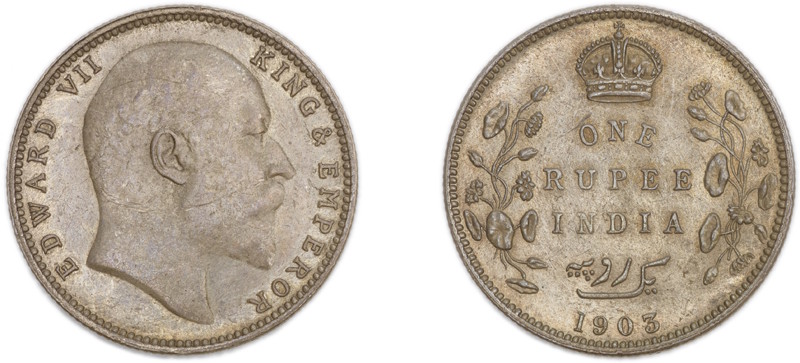
Silver one rupee of King Edward VII, 1903 (1921.2.5)
Manchester Museum, The University of Manchester


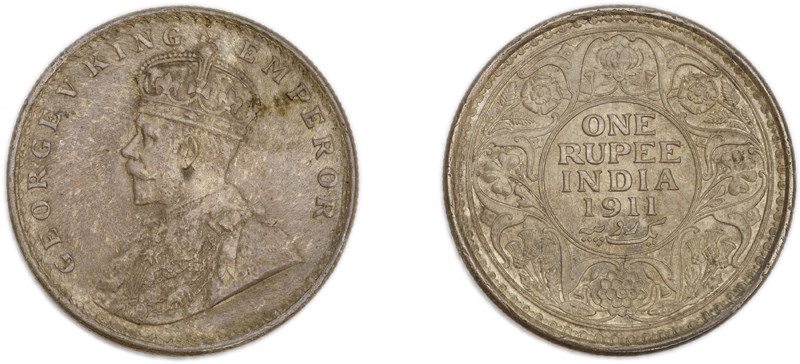
Silver one rupee of King George V, 1911 (1921.2.8; diam. 31 mm)
Manchester Museum, The University of Manchester


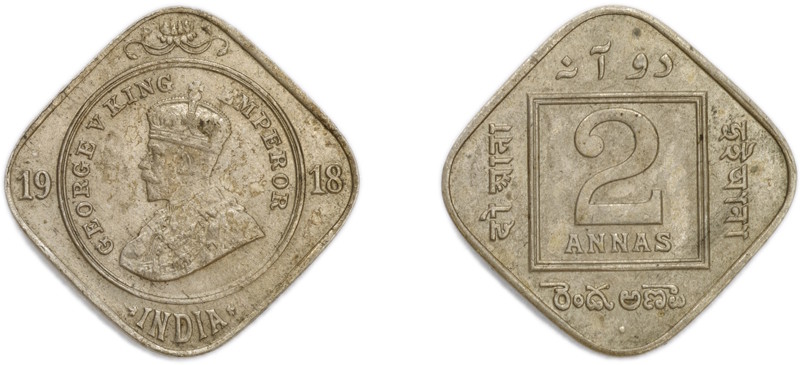
Cupro-nickel two anna of King George V, 1918 (1921.1.110) (1921.1.110; width 26 mm)
Manchester Museum, The University of Manchester


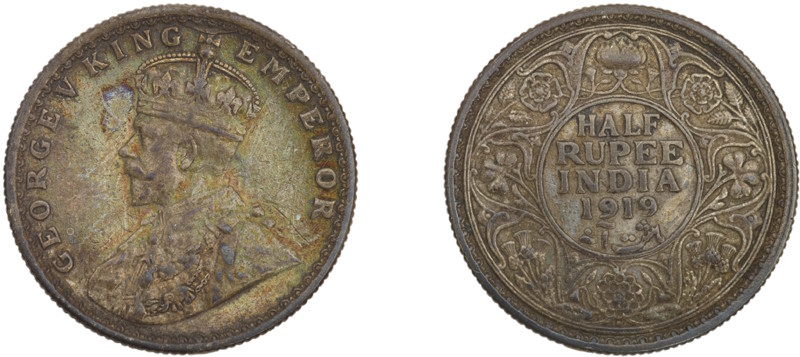
Silver half rupee of King George V, 1919 (1921.2.16; diam. 24.5 mm)
Manchester Museum, The University of Manchester

The end of coins?

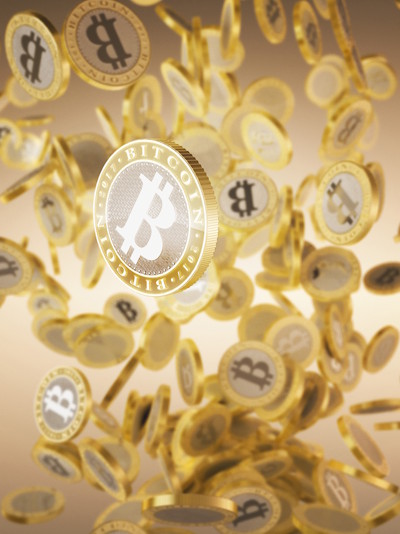
Conceptual illustration of the Bitcoin cryptocurrency. Bitcoin is a type of digital currency, created in 2009, which operates independently of any bank. Certain vendors now accept bitcoins as payment for goods or services. Mark Garlick / Science Photo Library

One of the consequences of the digital revolution is that we no longer depend on money in the form of banknotes and coins to make payments. Today, people can pay for goods and services using a debit or credit card and increasingly many people use a smartphone. Bitcoin and other crypto currencies take us another step further from physical money. For many, it is more convenient to make contactless payments. The result is that we are not using as many coins and banknotes. Finland has done away with using coins altogether. Sweden abolished cash on 24th March 2023.

People who are not familiar with, or who cannot afford, smartphones and other technological devices risk being left behind, resulting in greater inequality and poverty in our society and economy. There is also the growing environmental impact of digital currencies. Bitcoins' annual electrical energy consumption results in carbon emissions equivalent to those of entire countries such as Norway and Philippines. In 2018, these corresponded to nearly 49,000 hours of YouTube viewing (a year is 8760 hours). If not limited, such emissions can raise global temperatures by 2°C (degree Celsius) within the next three decades.

No longer having coins would also have other more day-to-day social and cultural implications, for example opening the lid of a tin, tossing a coin to make a decision, or playing the slot machines in an amusement arcade. For some families in the UK it was the custom to put a silver sixpence in the Christmas pudding. Women’s suffrage campaigners here in Manchester defaced coins by writing messages on them to draw attention to their campaign for equal voting rights.

Whether coins and banknotes disappear because of digital technology remains to be seen. It would be sad if, in the future, the only place to see money was in a museum.

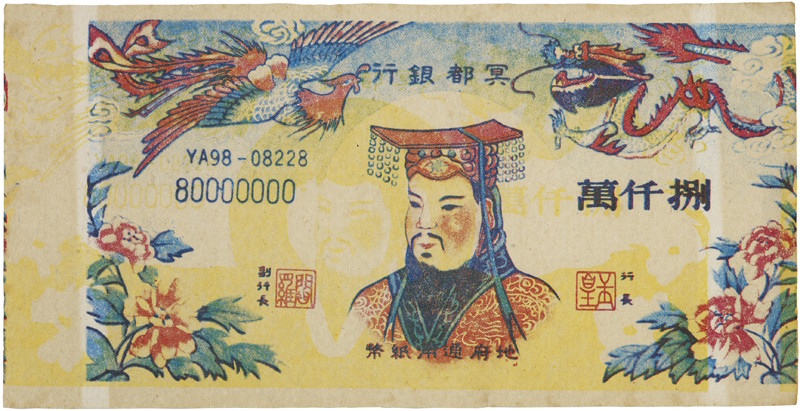
Eighty million Chinese Hell Money paper banknote, 2000s (OC397a; height 88 x width 170 mm)
Manchester Museum, The University of Manchester


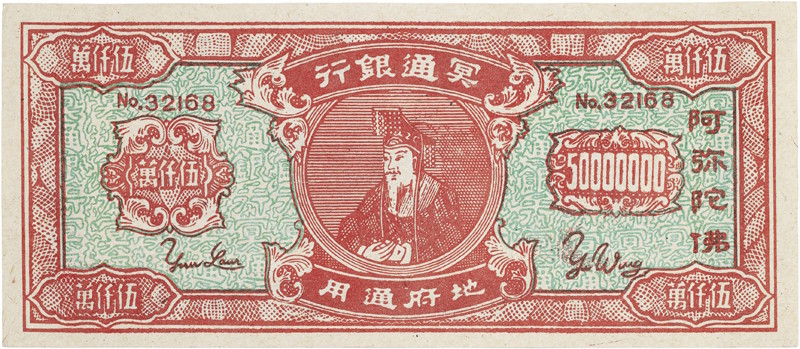
Fifty million Chinese Hell Money paper banknote, 2000s (OC396a; height 80 x width 184 mm)
Manchester Museum, The University of Manchester

No traditional Christmas dinner in the UK was complete without Christmas pudding. It used to be the custom to put a silver sixpence (equivalent to 2.5 new pence) in the pudding. This was an unexpected treat for whoever found it in their dessert at a time when sixpence might be used to buy a bag of sweets for example Caia Image / Science Photo Library


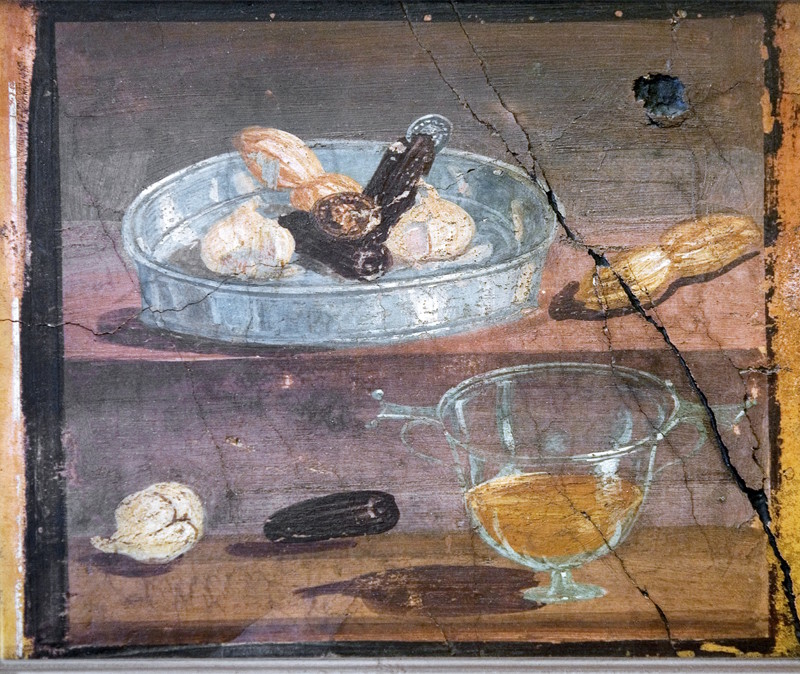
The association of money with food is vividly depicted also in this Roman fresco, from the House of Red Deers (Casa dei Cervi), Herculaneum, 45-79 CE. This detail of part of the fresco shows an arrangement of assorted foods, a glass dish, and a glass vessel, with gold and silver coins inserted in the fruit. The fresco is displayed in the Archaeological Museum of Naples, Italy Sheila Terry / Science Photo Library

Acknowledgements and credits

This online exhibition was created by Dr Stefano Locatelli during his ESRC Postdoctoral Fellowship at the University of Manchester, in collaboration with Bryan Sitch, Honorary Curator of Numismatics at Manchester Museum. It draws directly from Stefano’s research on money as a product of human activity and a medium with its own distinctive political, social and cultural dimensions throughout history.

Stefano and Bryan are grateful to the Economic and Social Research Council and Manchester Museum for funding this online exhibition. This would not have been possible without the collaborative effort of many individuals and institutions. First and foremost, they wish to thank George Young, Head of Exhibitions and Collections, and John Peel, Collections Information Manager at Manchester Museum, for their guidance and help. John, in particular, played a key role in coordinating the project and bringing the exhibition to completion. Special thanks also go to the Economy Museum – Royal Coin Cabinet in Sweden, its director Cecilia von Heijne, and photographer Gabriel Hildebrand, as well as to the Medagliere of the Museo Nazionale Romano in Rome and its director Gabriella Angeli Bufalini, for generously providing some of the images for this exhibition. They are also grateful to Richard Abdy and Barrie Cook, Curators in the Coins and Medals Department at The British Museum, to Ismail Erturk, Senior Lecturer at the Alliance Manchester Business School, and to Philipp Roessner, Professor of Early Modern History, and Aashish Velkar, Senior Lecturer in Economic History at the University of Manchester for their invaluable advice and input during the development of the exhibition. Aashish also kindly contributed an early draft of the text for Section 7. Stefano and Bryan further thank Heather J.A. Thomson for her artworks with German papiermarks. Website design by Peter Farmer, FDA Design. Website build and online installation by Ryan Billau, Illuminaries. New collections photography by Michael Pollard. Additional Images provided by Science Photo Library.

Stefano Locatelli is a historian of late medieval Europe and the Mediterranean, focusing on the monetary history of the Italian peninsula between 1200 and 1500. His first monograph, The Florentine Florin. The Politics and Culture of Money in the Middle Ages (2025), explores the gold florin’s political, social, and cultural dimensions, emphasising the role of human agents and political institutions in its history.

Stefano trained as an archivist at the State Archives of Milan and earned a PhD in Economic and Social History from the University of Manchester in 2019. He has held research fellowships from institutions including the Italian Institute for Historical Studies, the UK Economic and Social Research Council (ESRC), the Italian Academy at Columbia University, the British School at Rome (declined) and the Leverhulme Trust (Early Career Fellowship at Queen Mary University of London). From 2022 to 2024, he was Assistant Professor of Economic History at the University of Parma under the 'Next Generation EU' scheme. He is currently a Marie Skłodowska-Curie Postdoctoral Fellow at the University of Milan, in collaboration with Fordham University. Stefano co-edits The Italian Coins in the British Museum series and has collaborated on projects with Princeton University, the British Museum, the Ashmolean Museum, and the University of Milan.